Native American Cave Burials Primitive Calvaras California Skull Natural or artificial holes in the ground, caverns, and fissures in rocks have been used as places of deposit for the dead since the earliest periods of time, and are used up to the present day by not only the American Indians, but by peoples noted for their mental elevation and civilization, our cemeteries furnishing numerous specimens of artificial or partly artificial caves. As to the motives which have actuated this 127mode of burial, a discussion would be out of place at this time, except as may incidentally relate to our own Indians, who, so far as can be ascertained, simply adopt caves as ready and convenient resting places for their deceased relatives and friends. In almost every State in the Union burial caves have been discovered, but as there is more or less of identity between them, a few illustrations will serve the purpose of calling the attention of observers to the subject. While in the Territory of Utah, ...
The Cherokees Symbols
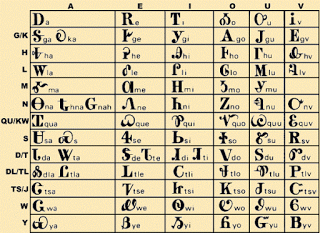 |
| Native American Cherokee Indian Symbols |
Everyone should know of Sequoyah or George Guess or Guest, as he was called in English. He was a Cherokee who loved to work at machinery and invent handy devices. He determined to invent a system of writing his language. He saw that the writing of the white men consisted in the use of characters to represent sounds. At first he thought of using one character for each word; this was not convenient because there are so many words.
He finally concluded that there were eighty-six syllables in Cherokee, and he formed a series of eighty-six characters to represent them. Some of these characters were borrowed from the white man's alphabet; the rest were specially invented. It took some little time ]for the Cherokees to accept Sequoyah's great invention, but by 1827 it was in use throughout the nation.
Types were made, and soon books and papers were printed in the Cherokee language in Sequoyah's characters. These are still in use, and to-day in the Indian Territory, a newspaper is regularly printed by the Cherokee Nation, part of which is in English, part in the Cherokee character. This newspaper is, by the way, supplied free to each family by the Cherokee government.
Komentar
Posting Komentar